


The ComSOP outlines that inspectors should identify the property’s primary structural material(s) and construction type in the report. Typically, the best approach is to identify clues in the exterior’s building envelope and inspect either unoccupied areas or where the structural system isn’t concealed (i.e., unfinished spaces, basements, equipment rooms, and utility closets).
The high-rise office building shown in the video features a curtain wall. Shown is the process of identifying the structural system behind it. Refer to the High-Rise Building Curtain Wall Inspection Video to learn more about the curtain wall itself.
High-Rise Building Structural Systems
Curtain walls are attached to the building’s exterior framing using anchors or mounting brackets, so the structural elements were concealed. By examining exposed elements in the ground-level white box space and in upper-level office suites, the structural system was identified as poured-in-place concrete based on the monolithic appearance of the floor slabs and columns.
In high-rise buildings, structural integrity involves more than strength alone. Engineers must also control building sway and acceleration, resist overturning and twisting forces, account for settlement and structural shortening, and accommodate facade movement. Lateral stability is the defining challenge of high-rise structural design. To address it, engineers use structural systems such as moment-resisting frames, shear wall or core systems, braced frames, diagrid systems, tube systems, or combinations of these.
High-Rise Building Construction Classification
The International Building Code (IBC) defines a high-rise building as “a building with an occupied floor or occupiable roof located more than 75 feet above the lowest level of fire department vehicle access.”
Under the IBC, commercial buildings are classified into five construction types, which align a building’s fire safety requirements with its size, height, and use. High-rises fall under Type I construction, the most costly classification but the only one that permits unlimited height and floor area. Structural elements must be constructed of noncombustible materials and protected to achieve the highest fire-resistance ratings required by the code.
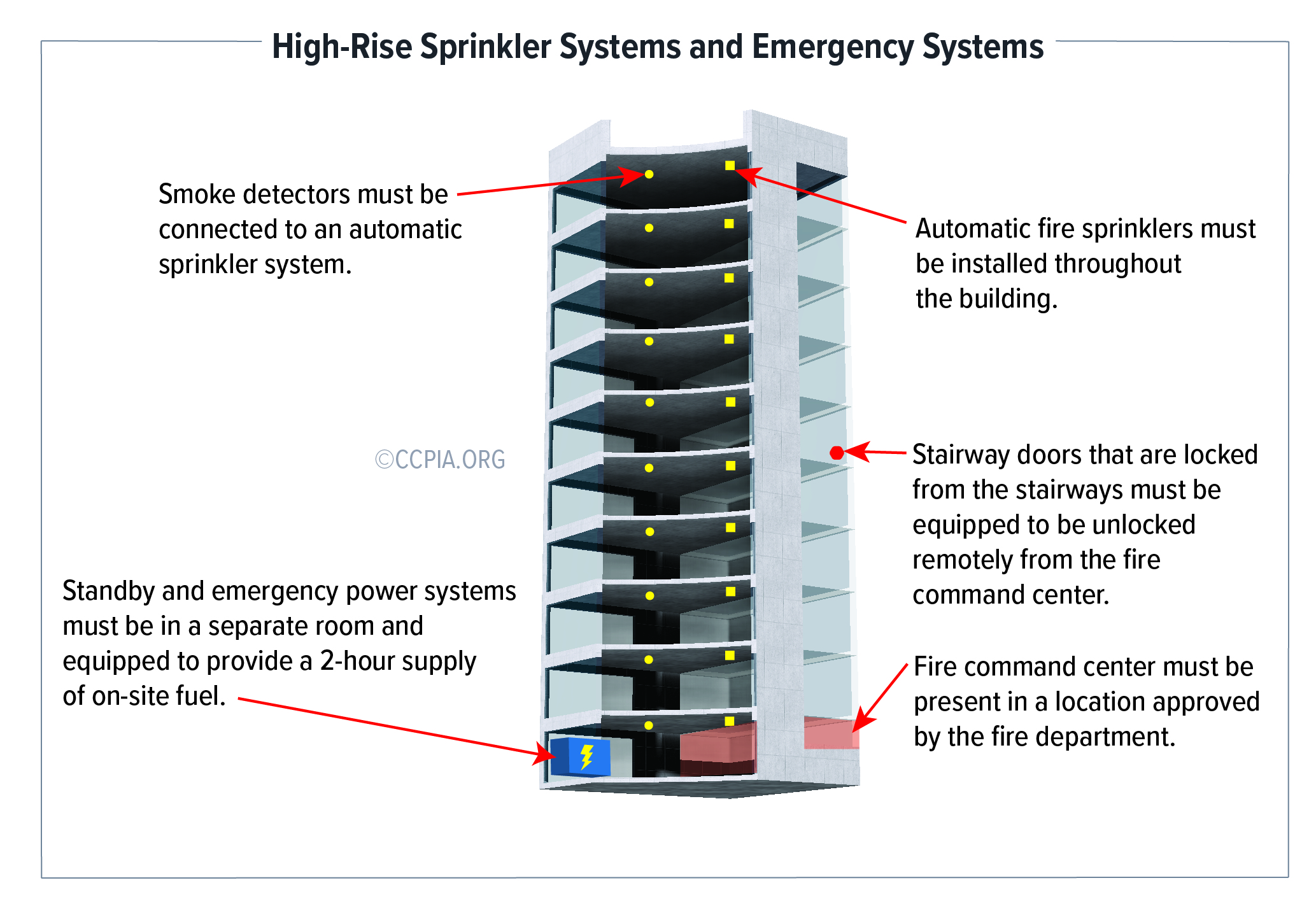
High-rise buildings are also subject to additional fire and life safety requirements. Consider that in the case of an emergency, the taller a building is, the longer the evacuation takes, and the greater the consequences of structural failure. To learn more on commercial fire and life safety systems, take the self-paced Inspecting Commercial Fire and Life Safety Systems Online Course.
Scope of Structural System Inspection
Regardless of scale, the same inspection principles apply to large-scale commercial structures. Commercial buildings should be plumb, level, square, and straight. Any deviations should be documented and evaluated to determine if further evaluation by an engineer is needed.
Photo-documentation should include both macro context shots and micro detail images. Inspectors are not required to perform engineering services or determine the building’s resistance to environmental forces such as wind, flood, or seismic activity.
For more information about inspecting commercial structural systems, take the Inspecting Commercial Structural Systems Online Course. This course covers the fundamentals of structural evaluations, including building design principles, load paths, structural types, and construction materials.