


In basic terms, smoke control systems manage the movement of smoke and air within a building and vary based on its design, use, and occupancy. These systems contain or exhaust smoke, heat, and other toxic gases. The goal is to maintain tenable conditions long enough for occupants to reach safety, support firefighter visibility, and reduce property damage during an emergency.
Smoke control systems in commercial buildings consist of both active and passive fire protection elements. Active elements include vents, dampers, and detectors, while passive elements include fire doors and fire-resistant walls, floors, and ceilings in stairwells and corridors. Detectors and control panels act as the “brain” of the system, coordinating system responses and signaling the activation of connected active elements.
Below is a review of the key concepts and components related to smoke control systems. For a comprehensive overview of active and passive fire protection elements, take the Inspecting Commercial Fire and Life Safety Systems Online Course.
Stairwell Ventilation
To control smoke in exit stairwells, buildings incorporate natural or mechanical smoke ventilation systems.
- Natural smoke ventilation: Uses thermal buoyancy and wind pressure to remove smoke, often referred to as the chimney effect. This is typically achieved through automatic opening vents (AOVs), façade windows, or roof-mounted louvers.
- Mechanical smoke ventilation: Often used when natural ventilation is not feasible or sufficient. Smoke and heat are removed using fans and ducts, while dampers control airflow and isolate areas as needed. Make-up air is introduced to maintain balanced pressure and controlled airflow.
The video below shows smoke vents installed in an interior exit stairwell as a natural smoke ventilation method.
Fire and Smoke Dampers
In commercial building fire and life safety systems, vents and dampers serve different roles. Smoke vents are part of natural ventilation systems, while dampers are containment components used within mechanical and overall smoke control systems. In essence, vents open to release smoke to the exterior, while dampers close to control its movement.
Smoke vents are typically found at the top of interior exit stairwells or other areas as roof-penetrating components, while fire and smoke dampers are installed where ducts pass through fire-resistive construction. Dampers serve a containment function by automatically closing to prevent the spread of smoke and fire.

Fire Damper
Although dampers and vents can be operated manually, they are primarily designed to automatically activate by a fusible link, a fire alarm system, or a combination of both, depending on the building design and level of system integration. Fusible links are heat-sensitive devices that activate a component when they melt.
Barriers and Compartmentation
Other forms of containment include barriers such as fire-rated walls, fire doors, and smoke curtains. The concept of containment in fire and life safety is based on compartmentation, which divides a building into sections to help prevent the spread of fire and smoke to other areas. Barriers are fire-resistance-rated elements used to achieve this compartmentation and support the structural integrity of the building under fire conditions. They are designed to withstand fire and smoke for a specified period of time. A fire-resistance rating measures the time, in hours or minutes, that a wall, floor, or door can withstand fire exposure.
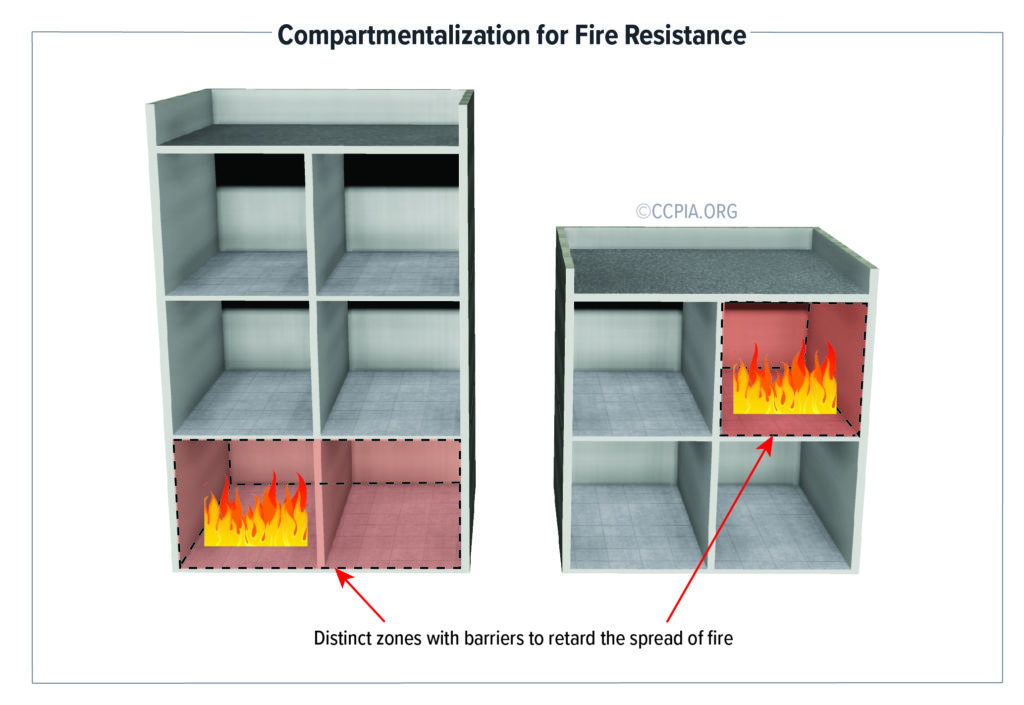
Fire-rated walls are permanent structural barrier assemblies. This concept may be familiar to home inspectors assessing fire-resistance-rated separations between garages and living spaces in single-family homes. In commercial buildings, fire-rated walls can include firewalls, fire barriers, or fire partitions, depending on the building design and required level of protection. Fire doors are operable openings within those walls that close to maintain the barrier. Learn how to inspect swinging, sliding, and rolling fire doors in the Fire Door Inspection Online Course. Smoke curtains are flexible or deployable barriers that are often concealed in the ceiling until activated by a fire alarm.
Barriers, dampers, and other ventilation components work together as a containment and compartmentation system. For commercial property inspectors, understanding these elements is key to evaluating how smoke is controlled throughout a building and how egress paths are protected during an emergency.
Inspection Considerations for Smoke Control Systems
To inspect smoke control systems in commercial buildings, inspectors must understand fire and life safety features and how buildings are designed and constructed to support them. This includes recognizing both active and passive systems, how they function together, and how they contribute to maintaining tenable conditions for safe egress.
For example, inspectors must be able to identify the means of egress and assess it for proper features, maintenance, and any field modifications. This includes inspecting the entire stairwell from the top floor to the ground level or exit discharge, verifying that walls and ceilings do not have unprotected openings, and checking that any HVAC or air-handling equipment passing through the stairwell is equipped with dampers to prevent the spread of smoke and fire.
Refer to the course below to learn how to complete a full fire and life safety inspection. It includes a coursebook PDF, inspection checklists, and a certificate.