


A lightning protection system (LPS) refers to an assembly of interconnected components installed on a building to intercept a lightning strike and provide a continuous path for electrical current to safely dissipate into the ground. The video above highlights common components of a lightning protection system observed during a 12-story office building inspection. Learn more in the self paced Commercial Electrical Systems Online Course, included with membership, and receive your certification upon completion.
Some of the key observations noted include:
- Unattached or improperly secured lightning rods and cabling
- Loose, damaged, or failing mounting brackets at parapet walls and rooflines
- Bent or missing lightning rods
- Loose, sagging, or separated cabling from the structure
- Disconnected, incomplete, or visibly compromised system components
What Is a Lightning Protection System?
By providing a continuous path to ground, a lightning protection system helps limit structural damage, reduce fire risk, and protect other electrical systems during a lightning strike. Commonly visible components include rods or spikes (air terminals), horizontal conductors (cabling), and mounting brackets on parapet and roof edges, as well as down conductors that extend to a grounding electrode system. In some cases the down conductors are concealed within the building facade.
Lightning rods are placed at corners, along ridges, and at intermediate points along the parapet or roofline, with spacing determined by industry standards (i.e., NFPA) and enforced by the AHJ. The image below illustrates common system components and generally accepted spacing practices.
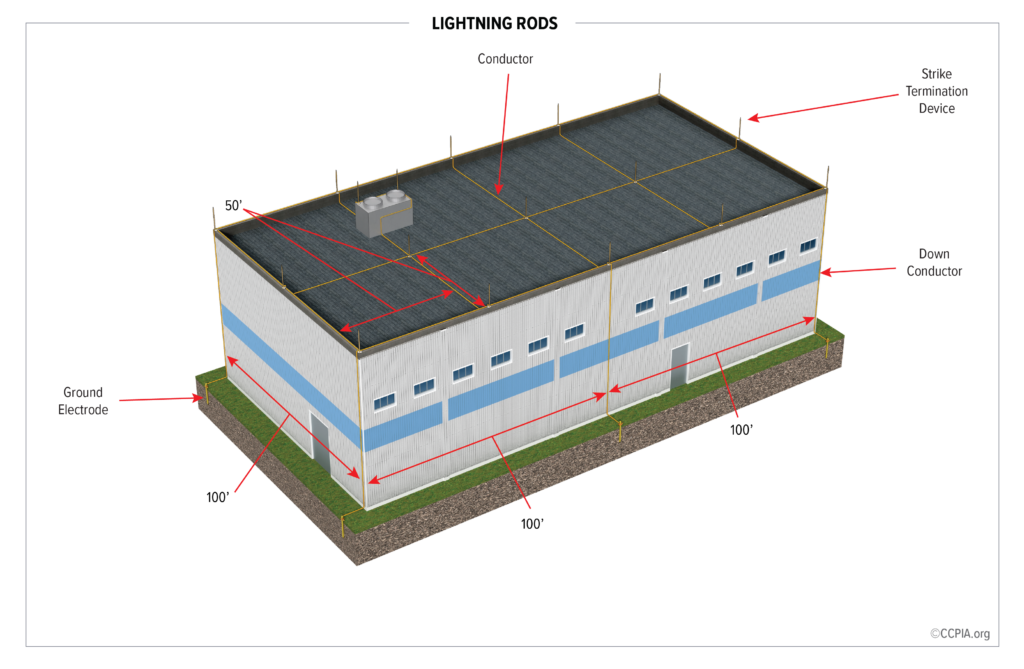
In the field, these components and the entire system are often referred to as “lightning arresters.” However, in an electrical context, a lightning arrester also refers to a surge protection device installed on electrical equipment, not the roof-mounted lightning protection system.
Commercial Property Inspection Limitations
The baseline scope of the ComSOP excludes inspecting lightning protection systems and any lightning arrestors. However, inspectors may choose to document obvious deficiencies, such as missing components, detached mounting brackets, and any visible deterioration or corrosion. These conditions should be assessed and corrected by a qualified electrical professional.
Inspectors should never physically touch lightning protection components due to the potential for unintended electrical hazards. A non-contact voltage tester can be used if available.
Learn more about inspecting commercial electrical systems in the Inspecting Commercial Building Systems Fast-Track Course. Held live on Zoom. This course covers how to inspect the major systems found in commercial buildings, identify common deficiencies, and apply a consistent approach across all property types.