


The ComSOP requires commercial property inspectors to verify the presence of a backflow prevention device at the main water supply, as well as backflow protection at points where cross-connections between potable and non-potable water sources could occur. Cooling towers are one example of a potential cross-connection point.
The video above covers why the cooling towers pose a cross-connection risk, what to look for at the backflow preventer, and what other devices are commonly found alongside it.
Learn how cooling towers operate and how backflow risks from cross connections are managed in the self paced Inspecting Commercial Plumbing Systems Online Course, included with membership and earn your certification upon completion
Why Cooling Towers Require Backflow Prevention
The cooling tower loop is exposed to the atmosphere and treated with chemicals to control biological growth. Without a backflow preventer on the makeup water line, contaminated tower water could flow back into the building’s potable water system, affecting the building or the municipality. The backflow preventer is designed to prevent contaminated tower water from entering the potable water system due to backpressure or backsiphonage.
Inspection Considerations
When identifying and assessing the backflow prevention device at a cooling tower, start by checking for leakage. Also confirm that the device is installed in the correct orientation. Backflow preventers have a flow direction marked directly on the body of the device, typically cast or stamped into the housing, and that marking must align with the direction water is intended to travel. Locate any inspection tags present and document them in the report.
Learn more about backflow prevention methods and common cross-connection locations in commercial buildings in the Inspecting Commercial Plumbing Systems Online Course.
Pressure Reducing Valve
A pressure reducing valve is commonly found alongside the backflow preventer at the cooling tower’s makeup water connection. Municipal supply pressure is often too high for the cooling tower, so the PRV drops the incoming pressure down to the operating pressure required for the appliance. At a cooling tower’s makeup water connection, the backflow preventer and PRV are commonly installed together and should both be located and documented during the inspection.
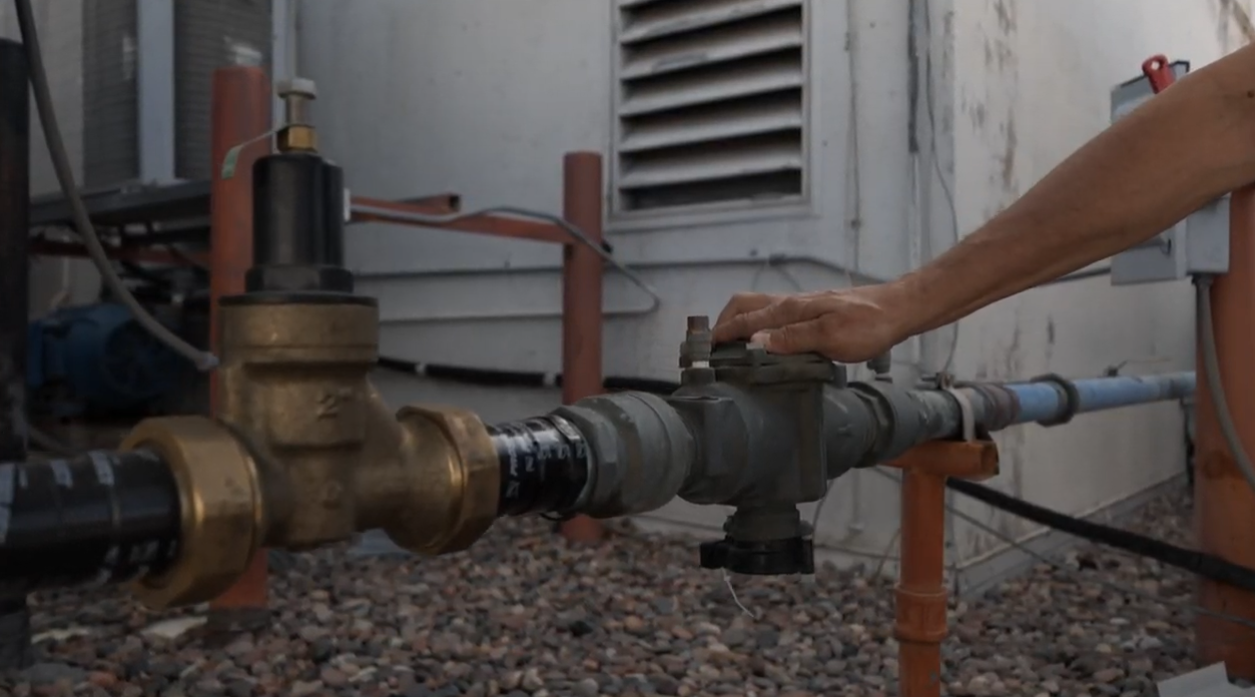
PRV (left) and Backflow preventer (right)
Understanding the System
The cooling tower in this video is part of a Water Source-Heat Pump (WSHP) system. The tower expels heat from the building’s condenser water loop to the atmosphere through evaporation, typically producing a water temperature difference (range) of about 10°F between the water entering and leaving the tower. Understanding the system helps you recognize why components like the backflow preventer are present and what they are protecting. For a detailed breakdown of how the heat pumps and heat exchangers in this system operate, see the Cooling Towers: Heat Pumps and Heat Exchangers video.
Inspector Takeaway
Before every inspection, have an understanding of the systems and components present. If a cooling tower is present, discuss with your client whether a visual overview and inventory of components will suffice, or whether a specialty consultant is needed for a more comprehensive assessment. A specialty consultant can provide greater insight into operational concerns and deferred maintenance.
Learn more about inspecting commercial mechanical systems in the Inspecting Commercial HVAC Equipment Online Course. It is a self-paced course that covers different HVAC systems and components, as well as designs and critical safety practices.