


A cost to remedy report compiles estimates for suggested remedies based on the conditions observed during a commercial property inspection and documented in the inspection report. It helps clients determine how much funding to set aside for repairs, replacements, and other work. The report is typically presented in a table, with each opinion of costs for suggested remedies referenced by the corresponding section in the inspection report.
Before the service starts, the inspector and client agree on the scope and dollar amount threshold for the cost to remedy report, and this is documented in the inspection agreement. For example, a client may want to be informed of any immediate work above $2,000. A key benefit of a cost to remedy service is helping clients with capital planning and budgeting by providing a clear understanding of the work needed to keep the property operating effectively and to reduce the likelihood of emergency repairs or higher future costs. In short, a cost to remedy report clarifies the property’s condition and offers an initial indication of the funds that may be required to perform the remedies.
Cost estimates should be gathered from reputable sources that account for current, local, and seasonal prices for labor, time, equipment, and materials. Common sources include RS Means, Repair Pricer, Marshall and Swift, and Craftsman, among other data platforms and books, as well as contractors and tradespeople.
→ Looking for training or report templates? Visit Cost to Remedy and Reserve Forecasting Resources for Commercial Property Inspectors.
Providing cost to remedy services typically entails:
- performing the inspection;
- writing the inspection report;
- selecting reported issues for the cost to remedy table;
- compiling costs for those issues with the scope and threshold; and
- attaching the cost to remedy table to the inspection report.
This service is typically offered in conjunction with a commercial property inspection. In some cases, cost to remedy services may be provided as a standalone service for repeat clients seeking maintenance projections or for general property management purposes.
Cost to remedy tables share some similarities with capital reserve tables. The primary difference is that a capital reserve table is a multi-year plan (i.e., five-, 10-, and 15-year) that helps determine the necessary funding to set aside for both immediate and capital expenses, factoring in compounding inflation. It’s important to note that, unlike a capital reserve study, a capital reserve table does not involve an examination of the status of the property’s reserve funding accounts or strategies. After mastering cost to remedy, inspectors may choose to expand their expertise to include capital reserve tables. Remember that the key to a cost to remedy table is that it covers immediate expenses.
Benefits of a Cost to Remedy Table
Commercial property inspections determine the overall condition of a property, while cost to remedy services go a step further by providing insight into the financial picture of the property as an asset. The benefits of this service can vary, depending on the client. Those clients who perform their due diligence when purchasing a commercial building can use the table to negotiate repairs, a lower price, and the first year of maintenance. Similarly, clients who currently own a building can determine the next year’s maintenance budget and evaluate their capital expense fund in comparison to required repairs. A capital expense fund for commercial real estate is a reserved amount of money set aside to cover significant expenditures for property improvements or major repairs beyond regular maintenance. Property owners interested in selling or leasing a property can use a cost to remedy report for similar purposes.
Overall, cost to remedy services give inspectors value-add options for enhancing their inspection reports. A commercial inspection report already supports capital planning, and when opinions of cost to remedy are added, it becomes an even more valuable capital planning tool for clients. Cost to remedy can be provided as an add-on to a commercial property inspection and offer opportunities for repeat business and additional revenue streams.
Examples of Cost to Remedy Table Items
The most common items identified in an inspection report and cost to remedy report are those items considered to be part of “The Big Three.” These are the three items that are typically considered the most costly to repair, maintain, and replace: parking areas, HVAC, and roofing. We’ll review some example scenarios below. Note that the costs listed in these scenarios are for example purposes only. Sources vary, including internet searches, contractor estimates, and published cost books.
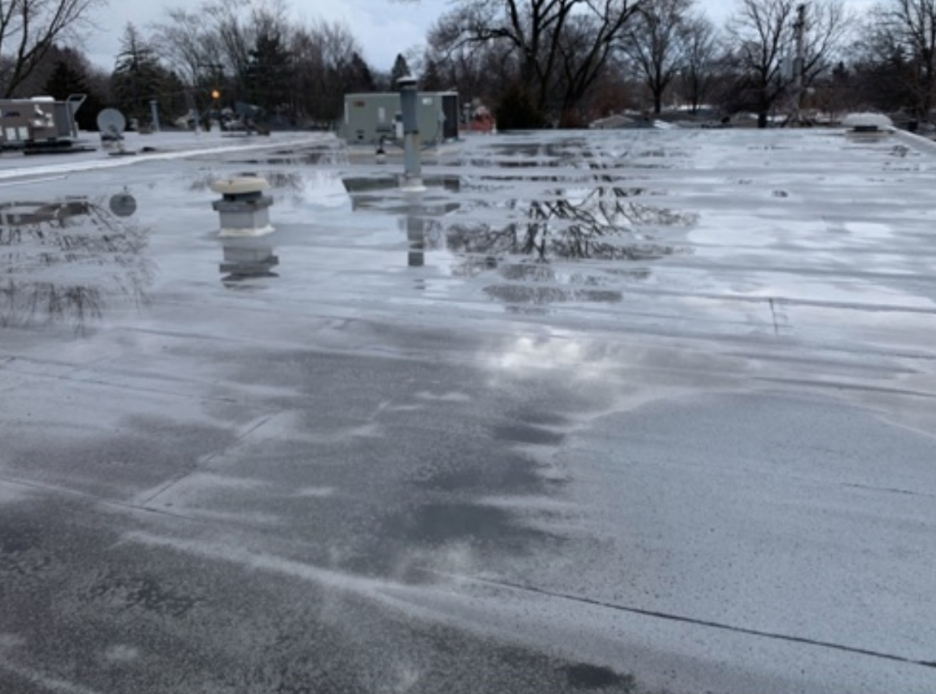
The roof is 11,000 square feet with a modified bitumen roof covering. This roof is at least 25 years old, with ponding and several recently repaired patches. This type of roof typically has a replacement cost of $11 per square foot, for a total replacement cost of $121,000.
 A specialty consultant conducted the inspection of all nine packaged units at the building. Each unit had issues, with some requiring replacement. The documentation provided a detailed cost estimate of $171,539 for both repair and replacement.
 This photo shows a 33,000-square-foot asphalt parking lot at a small shopping plaza. During the inspection of the parking area, the inspector found deep alligator-type cracking, many patches from previous repairs, and two catch basins with lids that were no longer flush with the pavement. Based on this condition, paving replacement is recommended. Using published cost data sources, the average removal and replacement of the asphalt parking area is $5.15 per square foot, for a total of $170,000.
Beyond The Big Three, most of the items found during a commercial property inspection relate to either maintenance or term replacement of other items. This includes attention to the windows and doors, sealants, and coatings, and any other issues noted in an inspection report.
 A specialty consultant found issues with the septic system. This system will require cleaning, as well as replacement and repair of some of its key components. The cost estimate provided by the specialty consultant was $27,091.
 The glazing strip or sealant around the aluminum frames has shrunk, leaving gaps and openings for water to seep into. There are also openings between the concrete tilt-up panels that will also require sealant. A specialty consultant determined that the cost to repair these items was $15,944.
Anatomy of a Cost to Remedy Table
A cost to remedy table is typically provided to the client with the final commercial property inspection report as an attachment. Its location within the report may vary, depending on company’s reporting standards. Some inspectors choose to attach the table at the end of their inspection report, while some choose to attach it next to the summary at the beginning. Any reference points and data from specialty consultants can be attached to an appendix.
Depending on the scope and the client’s preferences, a cost to remedy may include items such as:
- address of property;
- corresponding section in the commercial property inspection report for the item recommending attention;
- description of the item recommending attention;
- unit (i.e., square feet or unit number or description);
- quantity relating to the total number of units or quantities (i.e., 300 square feet, or 20 units);
- UL, which stands for useful life, also known as the typical estimated life expectancy of the item;
- RUL, which stands for the estimated remaining useful life of the item;
- immediate cost, which refers to the cost to immediately remedy the item’s issue(s);
- variance, referring to a margin of error or tolerable degree of deviation from the exact value for costs;
- standard and source(s) used (optional); and
- notice for the basis of costs that explains any limitations.
Depending on the inspector’s preferences and how the cost to remedy report is delivered, some inspectors may choose to include company and contact details, the inspector’s qualifications, links to resources, a key or legend, and more.
In essence, a cost to remedy table serves to answer the following questions:
- What projects should the client consider reserving for? (Include description, unit, and quantity.)
- How often do the projects occur? (Include useful life and remaining useful life.)
- How much does each project cost? (Include immediate costs.)
Visit the Document and Template Library to download PDFs of cost to remedy tables, capital reserve tables, reserve forecasts, and editable cost to remedy report templates.
Understanding Liability
There are straightforward approaches to handling risk management when providing clients with repair-replacement costs and other opinions of costs. The first step is setting clear expectations with the client by researching the property, conducting client interviews, and establishing an agreement between the inspector and client specific to the cost to remedy services. The agreement should outline a clear scope for the service, and state that estimates are not a guarantee or warranty that the repair costs will not exceed the provided estimate. Additionally, following the recommended key components of a cost to remedy report, as described above, is essential. CCPIA® has created a sample agreement template.
Download CCPIA’s Sample Cost to Remedy Reporting Service Agreement Template
Cost to Remedy Reporting Course
The purpose of this article is to review the basics of a cost to remedy table, including key definitions, service benefits, examples of reported items, the anatomy of a table, and liability concerns. In order to competently offer these services, inspectors must be proficient at performing commercial property inspections and reporting inventory, issues, and defects. The types of items to report depend primarily on the information gathered during the client interview and the building’s condition. Inspectors should register for upcoming training to learn how to offer opinions of estimated costs reporting services.
Learn more about the Cost to Remedy Reporting Fast-Track Course (held live on Zoom), or view the Training Calendar to register for an upcoming session.